


From 2015 to 2025, our business model was fairly normal. Salaried designers and developers, an expensive bench between projects, and a progressively miserable, burnt-out and jaded founder doing payroll math at 3am (me).
Closing Q1 2025, the tariffs had landed, design demand had collapsed for months, the trade war had our clients falling further and further behind on their invoices. By May we had two months of runway left.
→ So we stopped being an agency and became a platform.
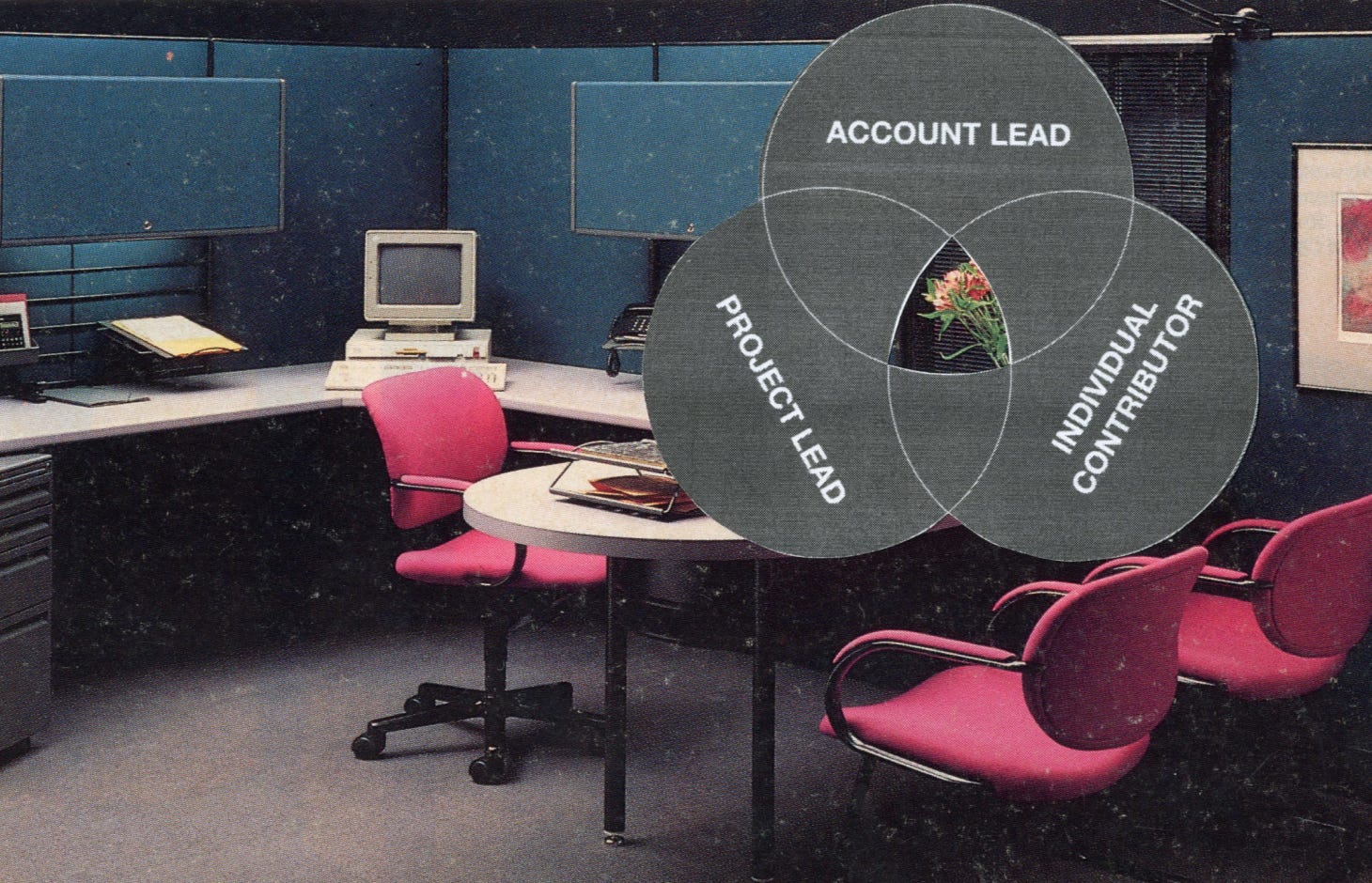
Today, our entire company is run by a simple formula that splits every client dollar between the business winner, the project leader, and the individual contributor.
Our top contributors earn +53% more than our best-paid salaried employees did previously. The business went from a -$695k operating loss to +$1.15mm profit. Our top creatives are pacing toward grossing $300k annually. When we ran our company-wide survey in 2026, company satisfaction had leaped forward.
In July 2025 our cash bottomed out at just $13k. By July 2026, we’d built back our cash reserves to $1.35mm, with a cohort of just 17 people. This is our new deal.
Being a bank is hard…
To be an agency is to be a bank.
In January last year, our salary liability was $500k+ per month across roughly 30 people. We needed to cover that every month, plus a buffer for churn between projects, software, legal, retreats, slow Decembers. Some months we’d even turn some profit!
Agencies are sometimes banks for their clients, too. Our client contracts have legal protections for late payment, but using them is a catch-22. Exercise the terms and you damage a relationship you spent years building. Worse, if the client is in real trouble, switching off their services might end their business. We pride ourselves on hospitality, so when an invoice went unpaid we’d usually just smile, absorb it, and extend a zero-interest loan until they managed to catch up.
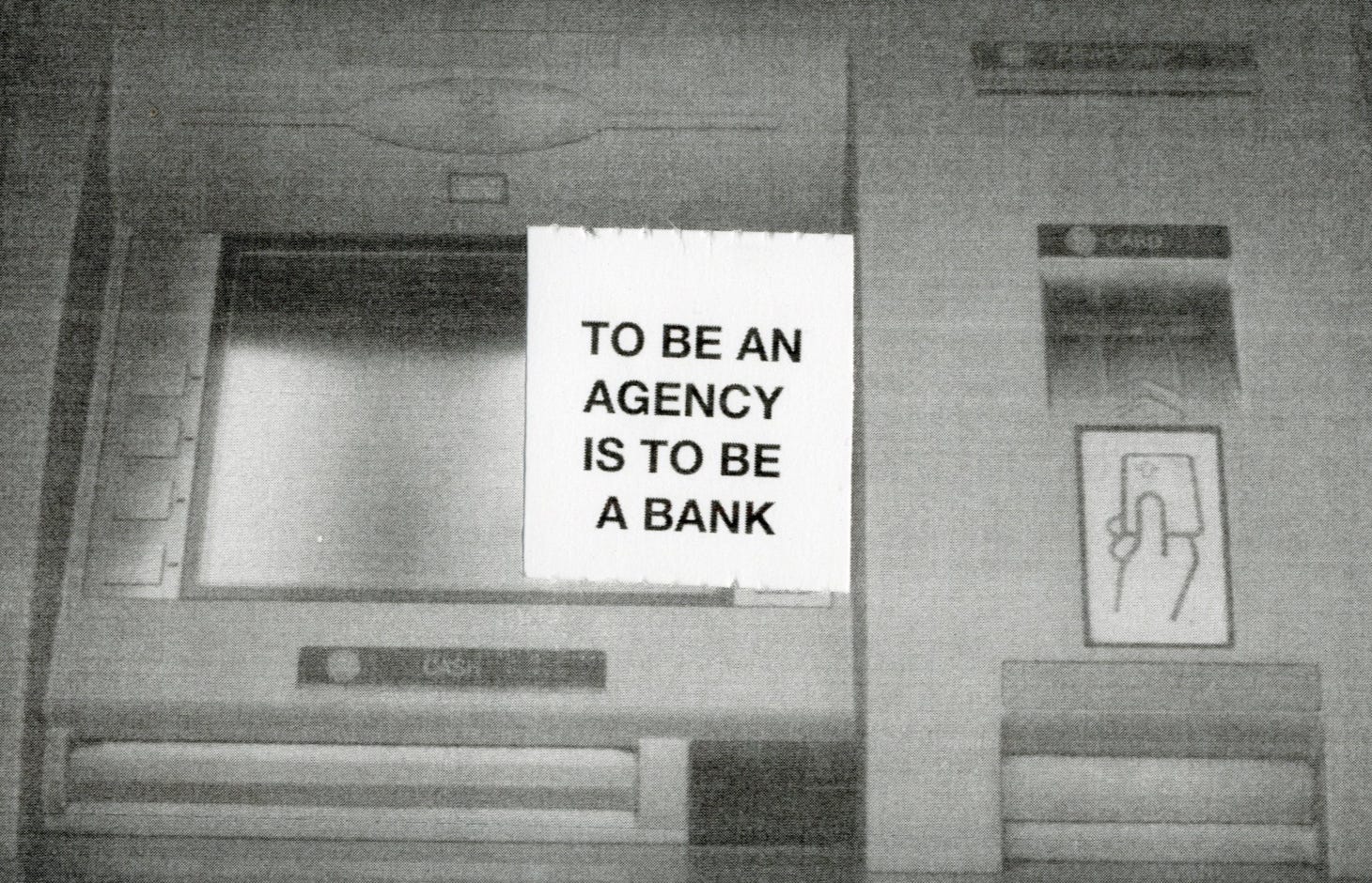
Agency owners lose sleep for years over the very real fear that outgoing salary payments might exceed incoming revenue for too many months in a row. We’re rarely more than 3–6 months away from going out of business. To be an agency is to be a bank both to your employees and your clients, in the worst possible way.
We’d skated on this thin ice for a decade. But then Trump 2.0 came into office and immediately started a trade war. Tariffs landed, and the market pulled back overnight. At the same time AI was convincing founders they could do more with less, and project budgets eroded quickly.
Design took it hardest. For a couple of quarters roughly half our design team was on the bench at any given time, taking a salary while booking no revenue. A traditional agency would have done layoffs, but that wasn’t in our DNA. Since founding, and across more than 150 people, neither XXIX nor Sanctuary Computer had ever let anyone go for financial reasons. The average contributor stayed almost five years.
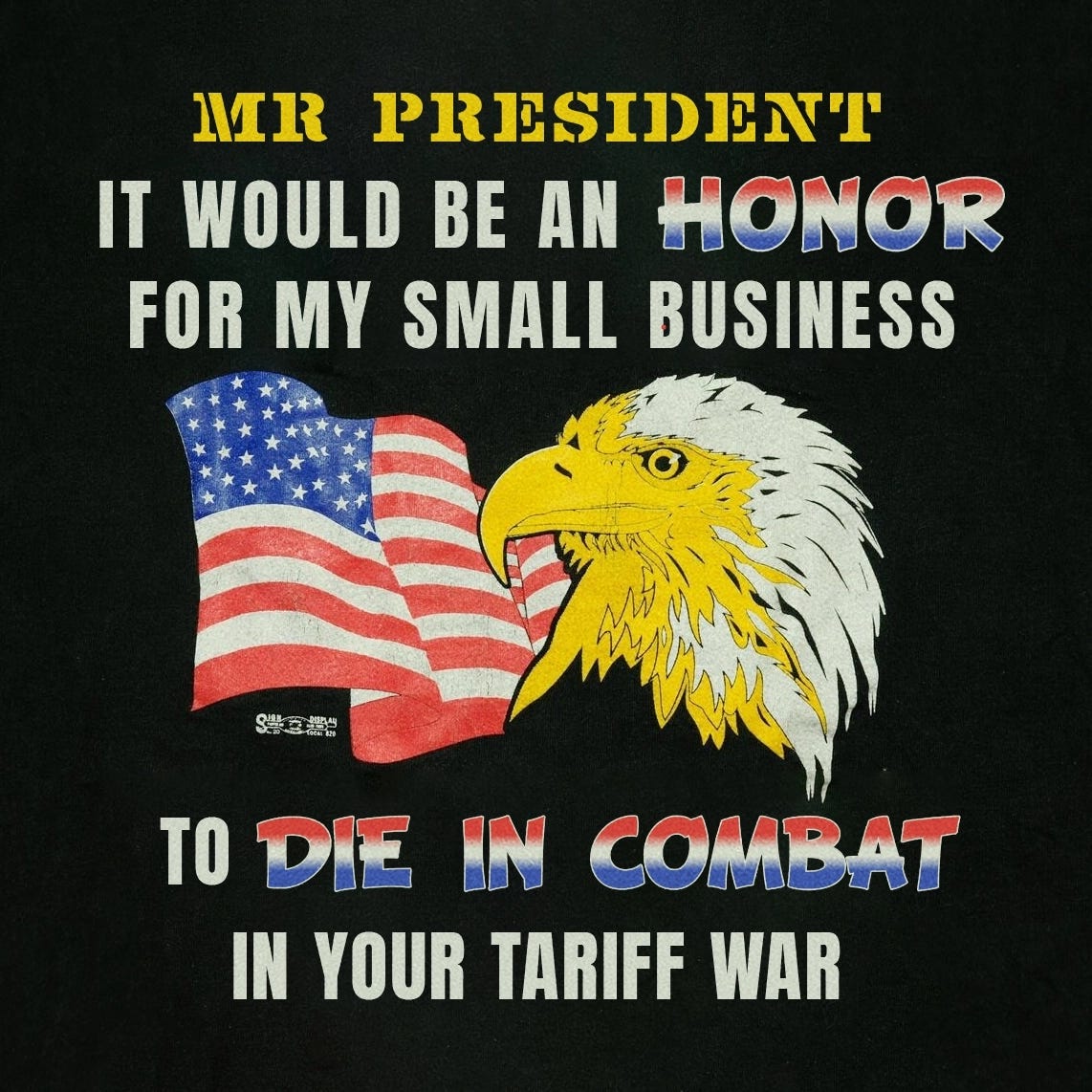
So we took it on the chin, like we always had. Clients were canceling signed projects. Others asked to push their invoices back. Some of our biggest accounts went months without paying, growing to $1.1mm in delinquent accounts.
In May 2025, after liquidating what was left of our cold storage cash buffer, I ran the numbers once again. We had less than two months left to live. There had finally come a run on our bank.
I called an emergency meeting with our worker ownership team to discuss our options. Lay off 30 to 40% of the company. Cut everyone’s salary. Move to a mandatory four-day week at 80% pay. Close the business. Nothing felt right, so we didn’t pick any of them.
…so we became a platform
In the middle of this chaos I spent a weekend talking to ChatGPT. Hours in, after a lot of dead ends, it asked whether I had considered an obscure model from the 90s called finders, minders, grinders.
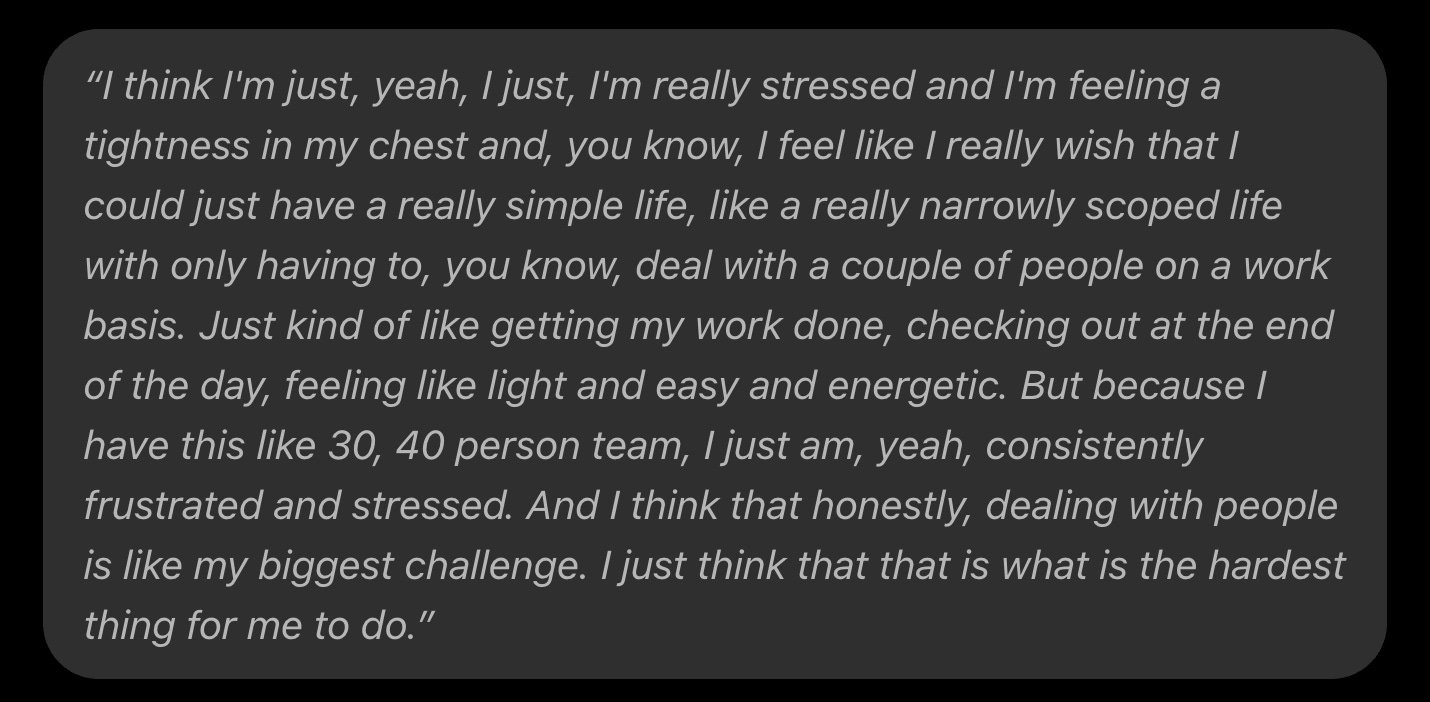
I hadn’t. David Maister wrote the canonical version of it in Managing the Professional Service Firm in 1993. The concept is simple. A firm contains just three roles:
Finders win the work…
Minders manage it….
Grinders perform it.
Every dollar is split between those three roles. It was suddenly clear how we’d survive, and further, how we’d face the uncertain future of creative boutiques industry-wide.
How we pay talent
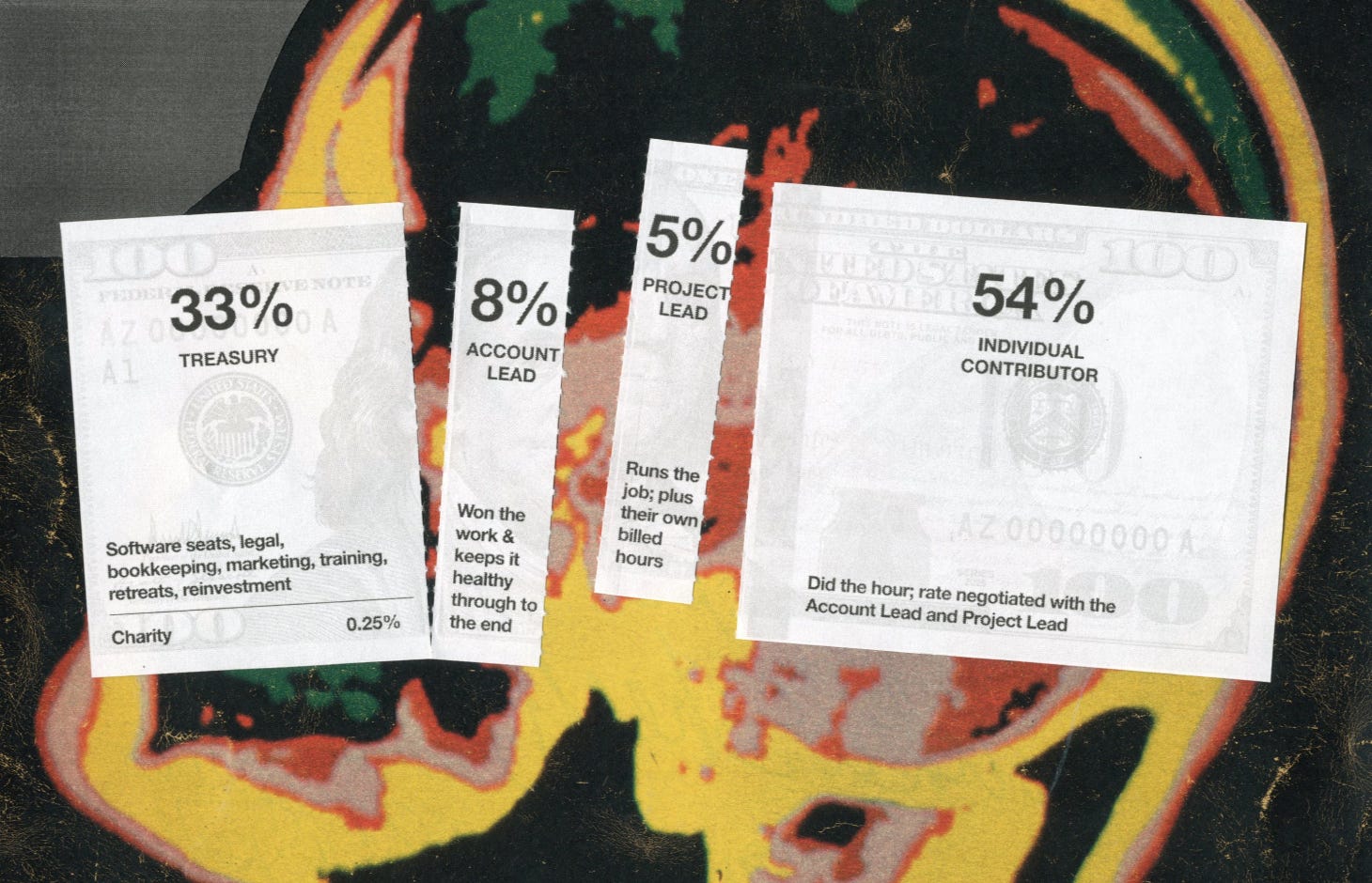
Here is how we split a single dollar:
The company treasury takes a
33%share of every dollar a client pays. That money covers software seats, legal, bookkeeping, marketing, training, charitable giving, retreats, and reinvestment. The treasury gives0.25%to charity.Account Leads are paid
8%of all work they win, set up, and keep healthy through to the end of the engagement.Project Leads are paid
5%of every project they run, plus their own billed hours.Individual Contributors (ICs) are paid up to the remainder of that
54%pending seniority*, and negotiated with the Account Lead and Project Lead.All payments are due as soon as the client’s invoice clears.
*Whatever is left from that 54% cap becomes our surplus. We split that surplus across the whole team every quarter.
There is no salary ladder here, but there is a commitment ladder*. Most new contributors arrive on a single project, paid an agreed rate for the work. Some stay, start running projects, start winning clients of their own, and end up owning a piece of the company. Nobody is assigned a rung. You move by taking on more of the machine, and the formula pays you accordingly.
*At the top of our commitment ladder is ownership. A few years ago, I gave 80%+ of my ownership benefit to a worker-owned pool. Long-tenured contributors earn their way into owning garden3d itself.
Under our old salary bands, no individual (including me) made above $160k base (plus up to ~$25k profit share), however good they were or however much they brought in.
That ceiling is now gone:
Multiple senior contributors will clear $250k+
A mid-level developer who converted from salary earned $184k in their first year, up from $107k in total comp the year before
Another who joined mid-year is pacing toward $215k
One person grew their quarterly take-home by $28k, an 82% jump in a single quarter, by stepping up to lead more accounts
→ Our designers are up 38% and our developers up 59%.
The model is made to bend and not break. When things slow down, the company breathes out. A quiet quarter is a quiet quarter, and nobody is paid until the client’s invoice clears. Unhappy clients pay slowly, so everyone goes over and above. There is more carrot than ever here, and you are your own stick.
What if you prefer W2?
The obvious objection to our new structure is that we took away people’s salaries and benefits and called it progress. That’s not the case. Our new structure calculates what we earn, but it doesn’t care how it’s paid out.
→ If you are US-based and billing more than 120 hours a month, you can choose to take your share as a W2 employee with healthcare, dental & vision.
The base salary is deliberately low, near New York’s minimum wage for salaried exempt work. Throughout the year we issue a bonuses to bring your take home up to your attributed earnings, as per our formula*. This option exists to smooth your income and anchor healthcare and benefits, but not to sever the link between what you do and what you are paid.
*As a W2 employee we set aside 50 cents on wages, employer payroll taxes, health elections, administration. Net of the coverage, choosing our salaried option costs somewhere between $20k and $28k a year. True ups are paid as W2 bonuses and are taxed as such.
Whether that trade is worth it is personal. We’re here to provide the infrastructure for you to do your best work.
Salaries have never meant security
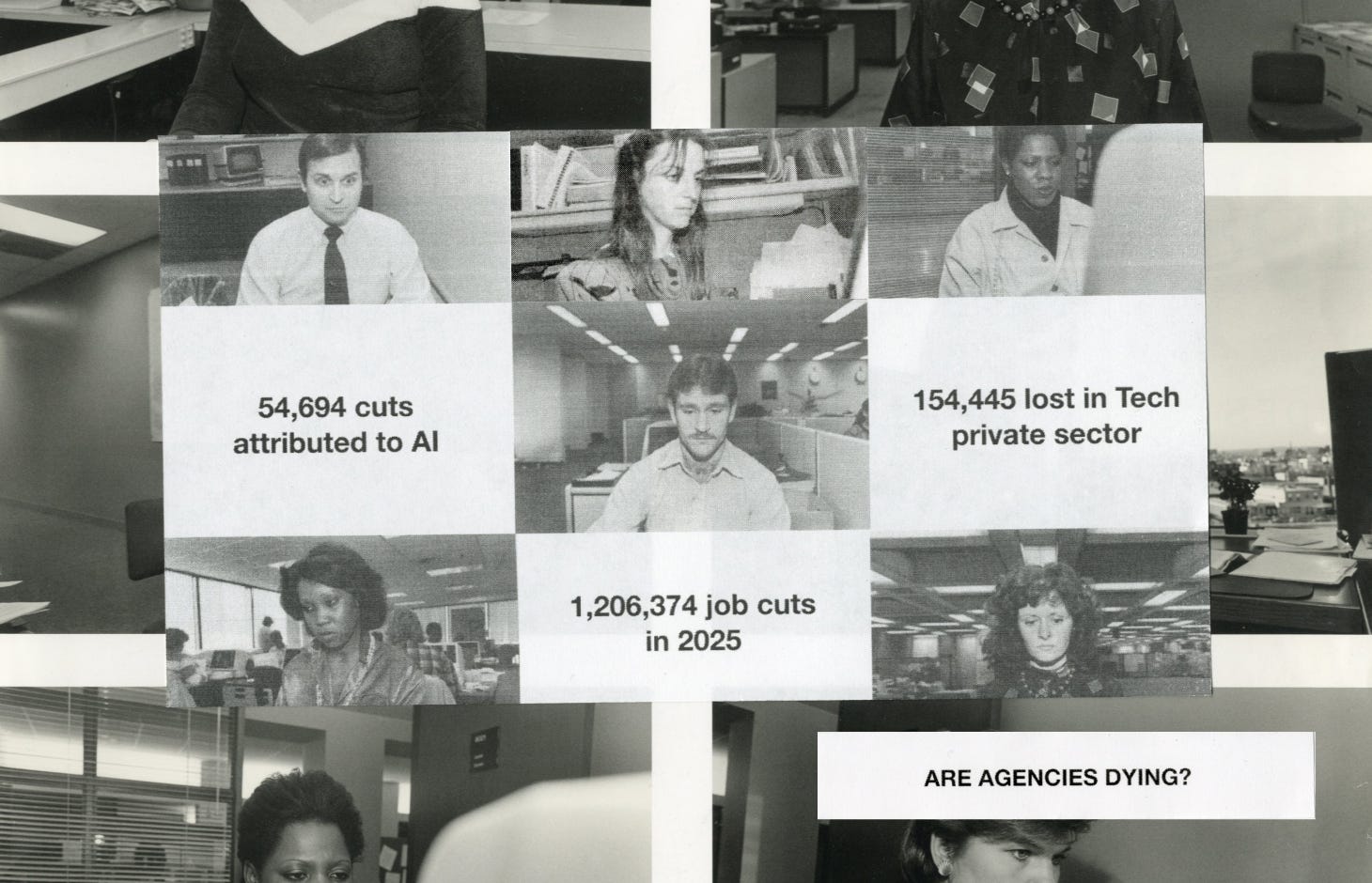
A salary is supposed to feel like job security. In the USA, it mostly isn’t. US employers announced 1,206,374 job cuts in 2025, the highest number since 2020. Technology led the private sector with 154,445 of them. Challenger, Gray & Christmas attributed 54,694 cuts specifically to AI.
Under our salaried model, we collected money from clients, held roughly 60% of it, and paid it out in even monthly amounts, keeping a buffer for the months when cashflow got tight. That buffer was our team’s money too, just withheld involuntarily and smoothed out. No one actually likes their money held back, so why were we doing that in the first place?
Earlier I said that we had never let anyone go for financial reasons. In May 2025, we finally did - once and for all. Our reduction in force offered our team two options: priority access to our lucrative new contractor basis, OR four weeks of severance. Eight people took severance and left. I didn’t pay myself a dollar for 4+ months while we stabilized things (we had $13k left in the bank at that time).
I’ve come to think that our new model offers far superior life security. Today, we pay our contributors as much as we can on the front end instead. If they need more than a PTO-shaped block of time off, they can work less to balance their needs outside of work.
Parents tend to care more about the liquidity of the their workload: flexible schedules that can dial up and down and be worked at odd hours allow parents to take turns distributing family tasks.
If client work ebbs and flows, we don’t need to end that working relationship dramatically or permanently. Instead, we all take a breather, wait for a new project to land. We’re all getting older and starting to have families. For this, our new deal feels far more humane.
The results
For our money
In the year following our new deal, we saw an net upswing of $1.85mm.
That swing didn’t come from paying people less. Overhead fell by more than half. We stopped having meetings about meetings. Fewer people delivered more revenue. Our cohort started growing again: we’re now a revolving door of roughly 40 creatives, over half having garden3d as their primary source of income.
For our team
Our companywide survey asks the same questions each year. This year, we had 39 responses.
The three highest scores are now transparency, autonomy, and whether your work matters, all at 4.29. Interestingly, the biggest single move was emotional maturity, up 1.60 points from 2.45.
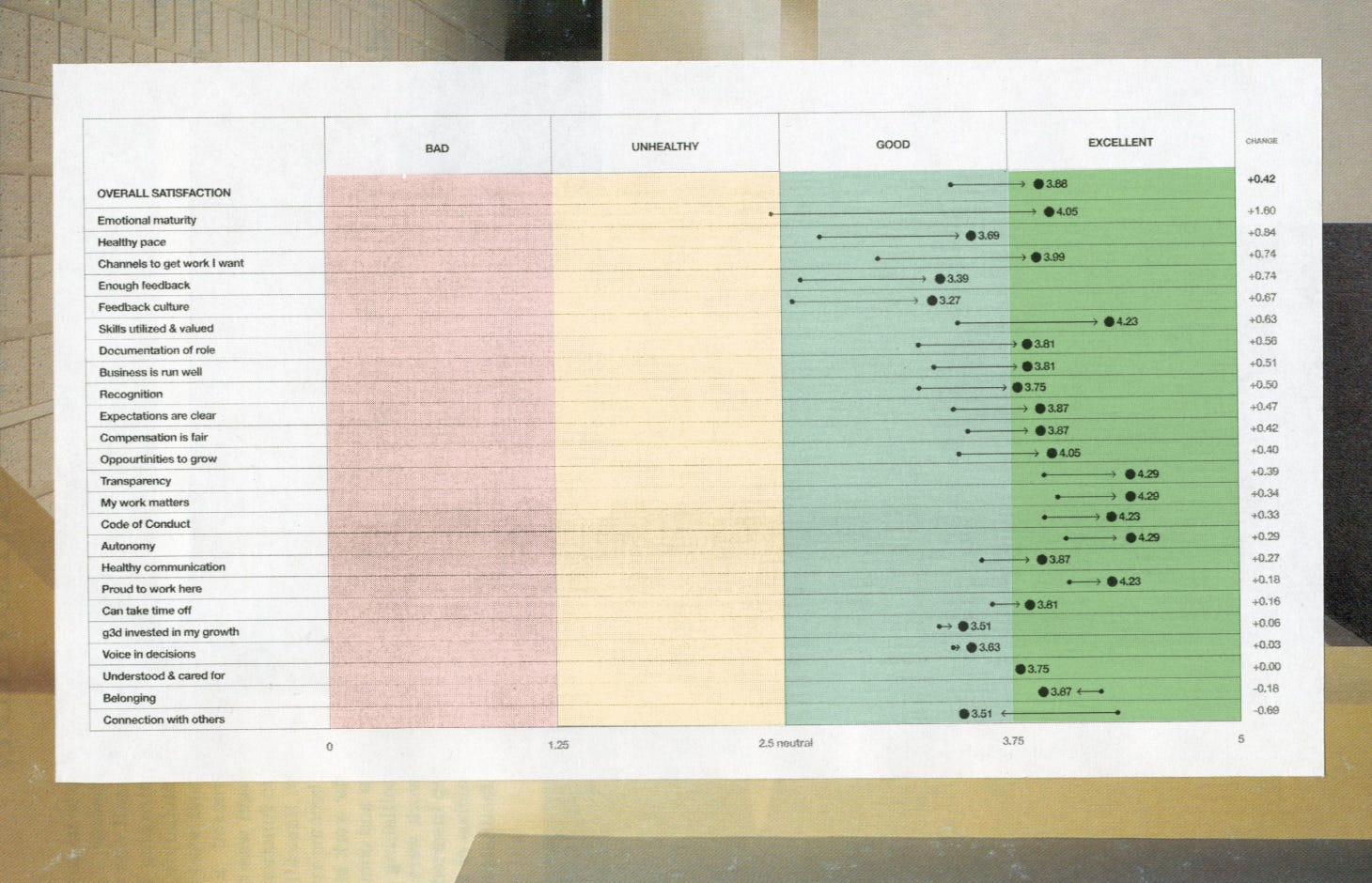
On the deal itself, “our compensation system is fair” rose from 3.45 to 3.87, with 17 of 21 agreeing. A new question about whether people have a clear path to growing their income and responsibility scored 4.05.
But our team put it better than I ever could:
“garden3d gave me an opportunity of a lifetime, and I’m genuinely so thankful for it. I’ll always be forever grateful!”
“We have an unusually talented, autonomous group of people, and I think that autonomy is one of our greatest strengths.”
“love how our company works and what we stand for. I’ll keep doing everything I can to help make garden3d as welcoming and hospitable as possible for our clients, our crew, and everyone who’s part of the company”
“It truly does feel like an environment where you get out what you put in. If you want to grow and upskill I believe the studio is invested in helping you do that”
“lots of processes have become streamlined since switching over to the New Deal, decisions are able to be informed and made in a timely manner which leaves more room for the actual work”
“The skill level that gets staffed onto our projects is quite high, so there are a greater number of people actively contributing to client projects at a rate and quality that meets or exceeds the expectations of the studio”
Why it works
From 2015 → 2025, we split over $2.1mm in profit via an algorithm I wrote in plain JS around 2016. It has since been forked and redeployed by creative studios all over the world. But our yearly profit share never really drove performance at our company. A team member once called it a “fancy bonus” they simply didn’t consider day to day.
I’ve always believed that working is a political act, so evolving our organization design has been a core part of our story: democratizing policy design through our experiments platform, autonomous working groups, democracy of information, peer-to-peer salary setting. The new deal is the most radical of them, but it isn’t the first.
It’s better for our clients
→ Our new model is better for clients too.
Under the old model the people on your project were the people who happened to be free, because a salaried bench is costly and needs to be used ASAP. Now, we staff for the work, and when a project needs a specialist we don’t have, we bring one in without costing anyone else hours.
Under fixed payroll, a cash cow project is still better than an empty month. Now, we only take on projects that people are genuinely pumped to work on, so the team shows up better for the projects they opted in to. The work is better for it.
(We still turn down work that doesn’t meet our Moral Compass).
Our developers rate our work quality much higher than they used to. Confidence that our craft is industry-leading went from 2.67 to 3.85, and confidence that it meets or exceeds client expectations went from 3.00 to 4.04.
One of them put it simply:
“the circle of project leads is experienced and financially motivated to do a great job”
None of this has changed our client contracts. We’ve never been a traditional agency. Same agreements, same studios, same people doing the work. It’s an internal change in how money is shared.
Self-selecting for ambitious people
I’ve come to understand you can broadly divide most team members into two motivations. Some are driven by incentive: bonuses, recognition, the chance to do something great. Others move from consequence: performance improvement plans, write-ups, the threat of being managed out.
I’m incentive driven, so naturally our first five years we were all carrot and no stick. Profit share, salary laddering, worker ownership, unlimited vacation. Then we grew into double digits and I couldn’t understand why some people quietly stopped performing the moment I left them alone.
Frederick Herzberg said in 1968’s Harvard Business Review: consequence produces movement, not motivation.
Or as I’d put it, you can’t PIP someone into great creative work.
Our new model solved this by accident. It’s a pure incentive model, so there’s no stick to administer, because there’s no salary and no manager whose job it is to poke you. Our creatives now make much more money, but only if they show up and work hard. People who need consequence to perform simply don’t choose to join garden3d at all (or just don’t last).
“Start erasing the line between operators, customers, and community members and squint; you begin to make out the shape of a group of people who can build for themselves and determine their own path of development.”
— Toby Shorin, Come for the Network, Pay for the Tool
Elie has often said that she never wanted to be a part of any club that would have her, until she met garden3d. Some of the most inspiring creative people I’ve worked with aren’t happy consolidating their practice into one company. They want side projects, experiments, clients of their own, a diversity of work and a flexible schedule that no single organization can offer them.
→ The strongest creative talent is best held loosely.
Now, we offer infrastructure for people who want to run the most exciting parts of their own creative practice, without having to build the rest of it themselves. We handle the invoicing, the contracts, the legal, the collections and the reputation. Our creative team brings their craft, and they take on as much or as little as they’d like.
As I argue in The Theory of Heads, creative people are entrepreneurial by nature, and they want a real share in the success of their work. What remains at garden3d is a talent-dense population of self-starting ambitious people, compounding day over day as they one-up each other.
Collectivism that embraces capital
Our new deal looks hyper-individualist. Reap what you sow. Eat what you kill.
In practice it’s closer to the opposite, because real autonomy is only possible when it’s shared. The group de-risks the freedom of the individual. You can take months off between projects without having to quit, because the platform holds while you are gone, and our fast moving river of work is still here when you return. Each of us is bigger and more resilient for being part of this elastic thing, far more so than we would be going it alone.
For well over a decade, our organization leaned collectivist and anti-capitalist. I’ve come to regret my naivety: I felt that being cooperative meant we also had to define ourselves as “against profit”, and treat the market as a hostile place from which to provide shelter. I’d often say to prospective employees that we were “a little bubble of socialism hidden inside the capitalist meat grinder”.
→ Today, I believe it’s more radical not to refuse profit motive, but to socialize it.
I’ve always said that this company should be a public utility, a foundation from which people build rich and dynamic lives. We exist inside of a hyper-competitive market, and pretending those pressures don’t exist doesn’t protect anyone. Rather, I’ve come to believe that we can be egalitarian, transparent and caring, while also being unapologetically good at running our business. The financial literacy that comes as a result is real empowerment. By stitching the individual’s own income to pro-rata splits of their team’s success, we are generative, not extractive.
What we’re still solving
According to our survey, interpersonal connection has declined. Six people independently asked for more face time. Less continuity between projects means fewer shared rhythms and less connective tissue, and when culture is opt-in, some people opt out by accident, just by being heads-down on back-to-back projects for months.
The second one is training and onboarding. Our model assumes high-impact independent contributors, and that’s a high bar for someone newer. We’re now much more concentrated at the senior level as a result.
We’re actively building dedicated training and support structures so we can bring on newer ICs and Project Leads more readily, and maintain our quality bar. More people advancing into responsibility means everyone earns more.
Year one was about building this new process. Year two is for strengthening our culture. If you have ideas, we want to hear them.
Where this goes
This piece opened with me doing payroll math at 3am. I don’t do that anymore. My own stress is 10% of what it has been for most of the last decade, which has improved the lives of everyone around me, and freed up time and attention I haven’t had in years.
Last year, we opened Index Greenpoint, and we’ve just built a new floor above our space in Chinatown. We acquired USB Club, rebranded XXIX and Sanctuary Computer, ran the Hey Mamdani! campaign, and started Family Intelligence with Mozilla Foundation. This is the most exciting and inspiring version of our company yet.
If you’re talented, ambitious, self-managing and driven, we want to hear from you. The best way in is to submit the strongest application you can to the garden3d creative network. We read every one by hand, and if it’s a 4- or 5-star application we’ll reach out the moment we have work that fits. Please apply.
If you run a studio and want to try this yourself, get in touch. We’d love to chat, partner, share work or even join forces. Email me hugh@garden3d.net
—
Shout out Kyle Richardson (RICH PLEASE) for the graphics. Many thanks to James Musgrave, Elie Andersen, Sam Taylor, Cameron Koczon, Toby Shorin, Drew Marshall, Bryan Lehrer and Evie Kling for the feedback and reviews.
Loved reading this
always an inspiration